
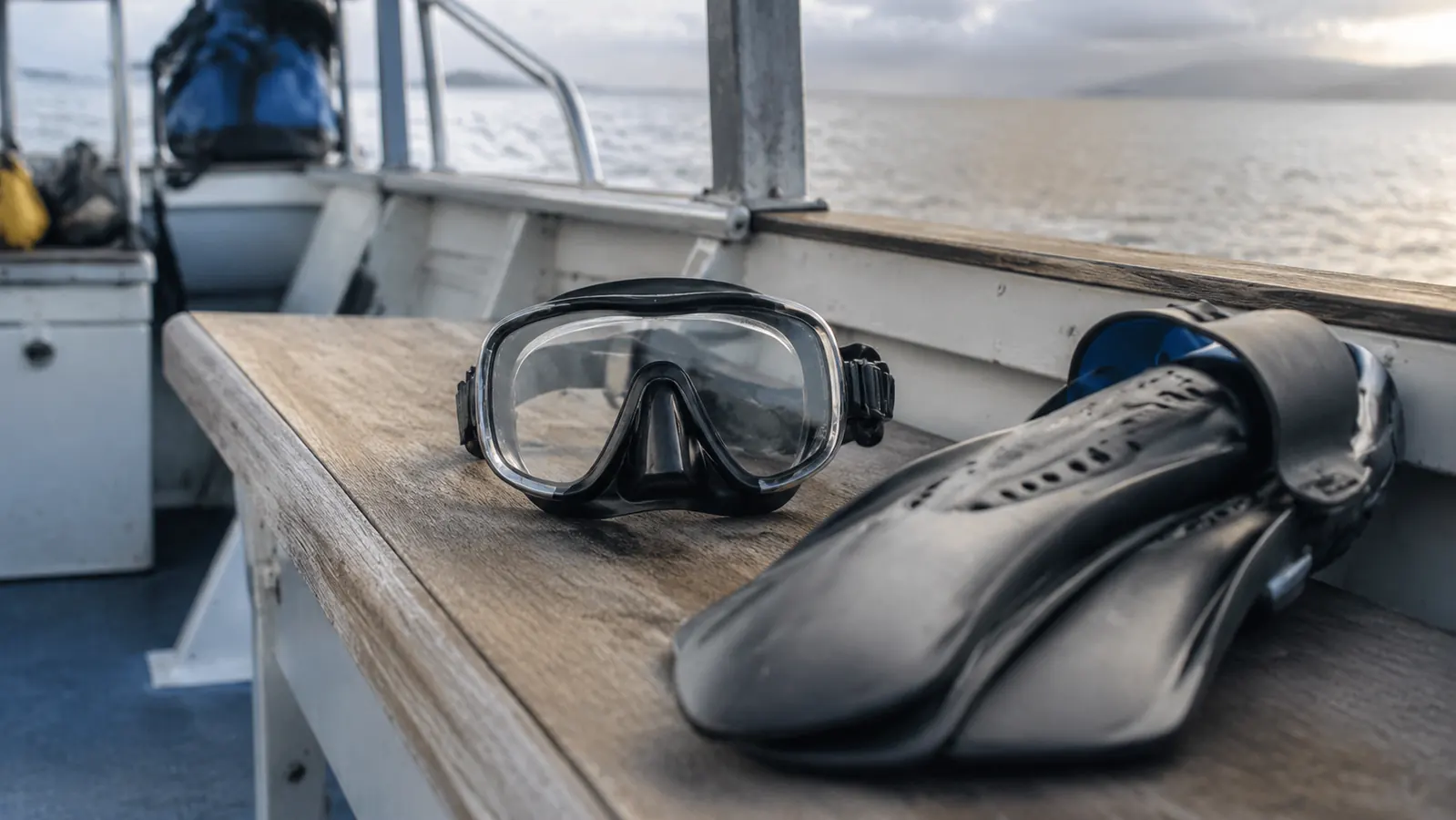
Fifteen years of masks, and every one of them found a way to talk me out of enjoying the dive. My first real one quit sealing under the bottom edge around year four, and the two-window Scubapro I switched to fogged at forty feet no matter how I scrubbed it. A discount mask off a resort rack in Florida leaked from the moment it hit the water. I reset them, defogged them, tightened them, and told myself the problem was the water, or the cold, or maybe my face. Then a divemaster on Roatan handed me his spare Cressi F1 and told me to wear it for the week and to quit blaming the ocean.
By the third dive I understood. That mask did not need me to talk it into sealing, it just did. I am a carpenter, and I have a rule about tools: something earns its place in my box by working the same on Tuesday as it did the first time I used it. The F1 did that, and two years and 180 logged dives later it still does. It became the most dependable piece of gear I own.
The Quick Verdict
Two years, 180 dives, zero leaks, zero parts replaced. The Cressi F1 still seals like dive number one, and it is the one mask I would buy again tomorrow.
Amazon Check Today's Price →The Mask That Ended My Leak-and-Fog Years
Two years and 180 dives in, the Cressi F1 has never leaked on me and has never needed a mid-dive reset. If you are done arguing with a mask that sneaks water under the bottom edge, this is the one I would put my money on. Check today's price and see why it is the most-reviewed mask on Amazon.
Amazon Check Today's Price on Amazon →How I've Used It
Before you trust any two-year verdict, you should know what it is based on. I am sixty-one, I dive for fun, and I am not easy on gear. This mask has seen spring quarry water in the low fifties, a week of wall dives off Roatan, a liveaboard in the Keys at three dives a day, and a flooded quarry with a sunken barge in the murkiest water it will ever meet. Water temperatures from 52 to 84 degrees, fresh and salt, boat entries and long shore swims.
I keep my dives in a spiral logbook the way I keep my saw blades inventoried, so I can tell you the exact count: 180 dives between August 2024 and this week. That number is what the pages say, not a round figure I picked. Every time the mask goes on I run the same seal check. Put the skirt against my face without the strap, breathe in gently, and the mask should hold on by suction for a slow count of ten. The F1 has never once dropped off early.
That same mask has been dunked in rinse tubs, packed flat in a carry-on, and once handed to a divemaster for a check-out dive when his own strap broke at the dock. When I get home it gets a freshwater rinse and hangs in the shade next to my wetsuit. I treat it the way I treat a good chisel: clean it, protect it from bangs, and expect it to do the job. That routine is why the silicone is still soft two years later.
One thing I want straight before the details: the Cressi F1 was the only mask on my face for all 180 of those dives. No rotation, no backup, no weekend off for a second pair. A durability verdict only means something if the gear was never spared, and this one was not. Same unit from dive one to dive 180, no replacements and no repairs.
Why a Frameless Mask Lasts Longer Than the Ones With Frames
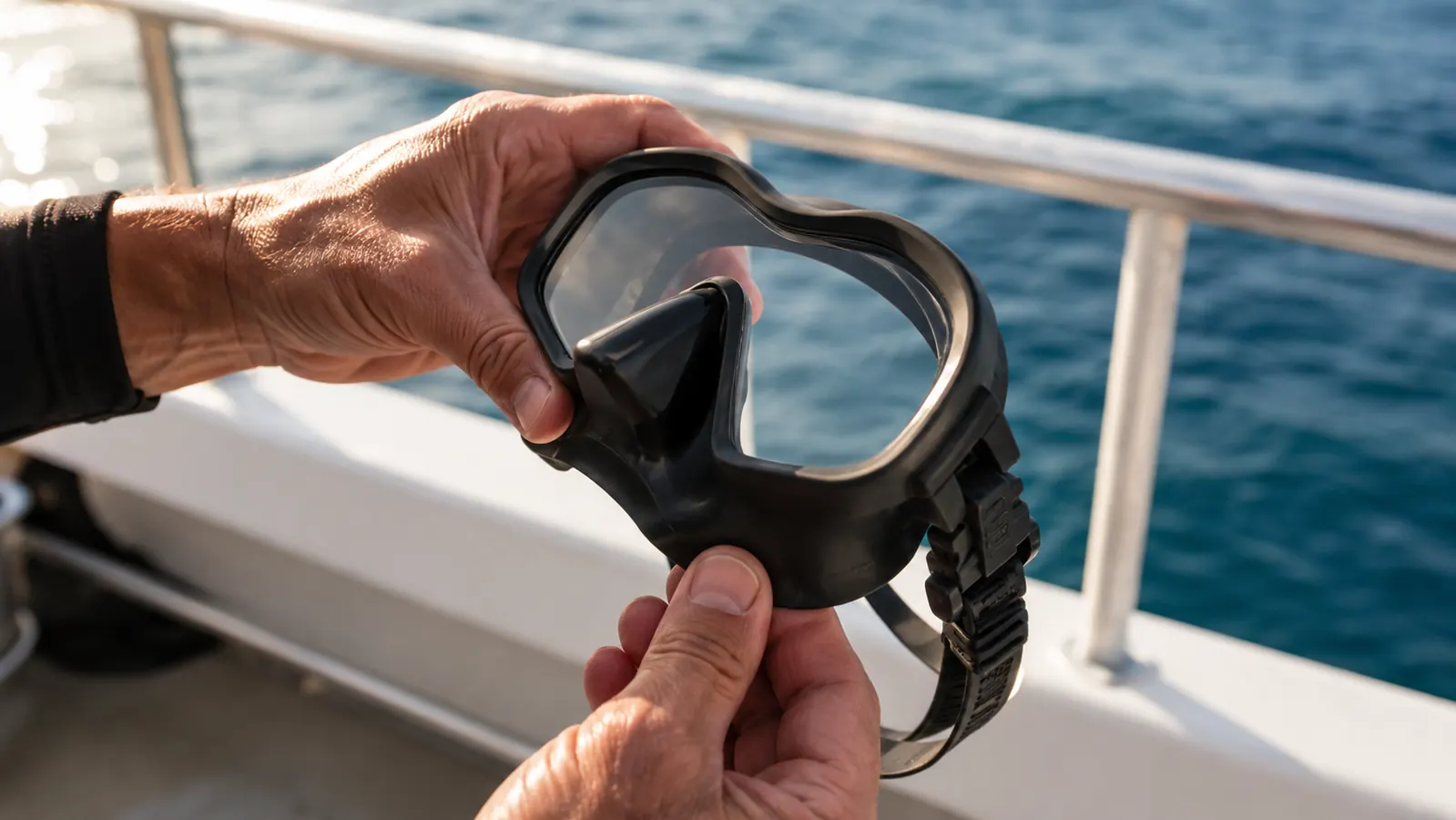
Here is what a frame does on an ordinary mask: it holds the glass, and the skirt hangs off the frame. That is a whole extra part, and a part is a thing that can loosen, warp, crack, or leak. On the F1 there is no separate frame. The silicone skirt does all the structure, running from the strap around the tempered lens, and the lens locks directly into the skirt. Same logic as a solid door jamb instead of three nailed-together pieces. Fewer parts, fewer things to come apart.
The practical payoff is that the F1 folds nearly flat. Mine has gone under an airline seat, down to the bottom of a duffel, and into a truck glovebox without a case, and it pops back into shape without a crease. A framed mask spends its whole life taking up three inches and defending its own frame from dings. This one takes up about the footprint of a paperback. I have sat on it once, folded flat under me for an hour on a boat bench, and it came out perfectly fine. Try that with a frame.
The lens is one pane of tempered glass, and that matters at thirty feet. It does not fog or scratch the way a plastic insert will. Mine has exactly two small marks after two years, both from carelessness against a boat gunnel, and neither sits in the line of sight. The single lens also means one uninterrupted window of glass, so the view above and below is more open than a spec sheet ever tells you.
What Actually Changed Over 180 Dives
The honest answer is less than I expected, but not nothing. The low-profile strap with its quick-adjust buckles has stretched a touch, about a half-inch looser than new, so I take one more click at the start of a dive and do not think about it again. The silicone still has its spring. I check the skirt before a trip the way I check a gasket, and after two years there is no cracking, no hardening, and no loss of the soft grip it has against my face.
Fog has not been a fight. I give the glass a rinse and a quick clear before long dives, and on the liveaboard week that routine carried me through three dives a day; my old two-window mask would have needed a scrub with defogger compound every third dive. The low volume of air inside clears in a couple of breaths. In 180 dives I have had to clear this one twice in a row exactly once, on a 52-degree quarry dawn, and I count that as a fine record.
The buckles were the part I expected to wear out first, because quick-adjust parts always do. Two years in they still click firmly and hold, and the strap has not frayed at the adjusters. If I have one caution, it is the lower edge of the skirt, the first place any mask shows its age. Mine is still solid, but it is the spot I inspect at the start of each season.
I stopped carrying a backup mask after the first year. That was the decision this mask earned. One mask, no spare, nothing. On the barge dive, where the current wanted to peel everything off my head, the F1's low profile stayed put, and that was the moment I knew the backup was staying home for good. It lives in the mesh pocket of my BCD between trips. That is a level of trust I do not give most gear.
Temperature is the long-term detail most reviews skip. A March quarry at 52 degrees stiffens the silicone skirt the way cold stiffens a rubber boot, and a tired mask shows itself right there, sucking air along the bottom edge the instant it hits cold water. The Cressi F1 comes back from a cold splash a little stiffer for the first minute, then seats fully by the time I am at twenty feet.
One hundred eighty dives, and this mask has leaked exactly zero times. I do not trust a lot of equipment that much.
It Packs Like a Pencil, Rides Like a Tool
I have flown with this mask eight or nine times. It goes into a mesh pocket or flat against the lid of my carry-on, and I have never packed it in a hard case. On the plane it rides in the same pouch as my spare regulator mouthpiece. On a liveaboard it drains dry in minutes because there is nowhere for water to pool. A framed mask traps water in the channels behind its frame, the F1 just lets it run off.
That matters on a trip. When you come up from dive two and have thirty minutes before dive three, a mask that is dry and ready is a small luxury. This one also never leaves a hard frame digging into your forehead when you park it on your head between dives, because there is no hard frame to dig. It sits on my face the way a good pair of work glasses does, present when I need it and forgettable when I do not.
Flat folding also buys a mask that is dry when you need it. No frame channel means the F1 drains in seconds on the boat deck, and I have never carried it dripping through a cabin. It is ready the moment the next dive is called, which is more than I can say for any framed mask I have owned.

Where It's Not Perfect
Nothing is perfect, and anyone who tells you otherwise is usually holding a price tag. The F1's view is plenty, but it is not the great sideways sweep you get from a big double-window mask. On drift dives and wrecks I turn my head a little more to look where I am going. If your diving is all about peripheral vision, that is a real tradeoff, not a nitpick.
The nose pocket sits close to the face, which is great for clearing and for equalizing with a bare hand. It is less great with thick winter gloves, where I end up fumbling a little before I find the pinch. And the fit is not universal. Two of my dive buddies cannot get this skirt to seal on their wider faces. I fit-tested it in the shop the way I tell everyone to, so I knew before I paid. A mask that will not hold to your bare face for a slow count of ten in a shop will not hold at depth.
None of that has made me want a different mask. But it is the difference between buying the F1 because it suits your face and buying it because everyone owns one, and I want you to know which one you are doing before you spend the money.
The Alternatives I Considered
I put the F1 face to face with the SCUBAPRO Spectra, the other frameless mask on every shop shelf, and the results surprised me enough that I wrote them up in a full head-to-head. Short version: the Spectra has a slightly wider view and a padded strap, and it sells for a good deal more. When the pricier mask does not seal any better on my face and does not pack any flatter, I do not feel smart paying the difference.
I also kept my old double-window mask in the bag for a full season and switched back and forth on purpose, to be fair to it. Every time I reached for the F1. If you want the reasons spelled out, including the places where the more expensive mask genuinely wins, the head-to-head is worth fifteen minutes. And if you are still on the fence about the frameless idea, I wrote the ten-part case for it too.
What I Liked
- Seal has held across 180 dives with zero mid-dive resets
- Folds flat enough for a glovebox or a carry-on, no case needed
- Single tempered-glass lens with a low internal volume that clears fast
- Quick-adjust buckles still click firmly after two years
- As low-maintenance as dive gear gets: rinse, shade, done
Where It Falls Short
- Horizontal field of view is narrower than a big double-window mask
- Nose pocket sits close, which is fumbly with thick winter gloves
- Lower skirt edge is the spot to inspect by year two, same as any mask
- Fit is not universal, wider faces should try one on before buying
Who This Is For
Buy the F1 if you dive regularly and you are tired of resetting a mask in the middle of a dive. If you want one mask that does cold quarries, warm reefs, wrecks, and a liveaboard week without a case or a backup, this is it. If you pack light, get the one that folds flat. If your last three masks leaked at the bottom edge, start here. It is priced to be the mask you stop thinking about, and that is exactly what it has been for me.
If you are newer, this is the mask I would put in your bag first. A mask that seals and clears without fuss leaves your first hundred dives about buoyancy and breathing, not about fixing your face.
Who Should Skip It
Skip it if your face is wide enough that the skirt will not seal on the sides, because that is a real thing and not a rare one. Skip it if you spend your dives watching things over your shoulder and want the widest window a mask can offer. And if you dive with thick gloves all season, try one on before you order. The F1 is the mask that suits my face, not the mask that suits every face, and if it will not hold to you in the shop for sixty seconds, it will not hold at sixty feet.
One more honest note. A mask you love is not automatically one your dive buddy will love, and I have watched the F1's shop test fail for friends who were sure they wanted it. When that suction hold drops the mask off your face, walk away. No review should talk you into a mask your own face has already judged.
The Mask I Will Be Wearing on Dive 181
Two years in, I have no plan to replace the Cressi F1. Same strap, same seal, same glass, still the first thing into my dive bag. If you are ready to stop arguing with your mask, this is the one I would point a friend to. Check today's price before your next trip.
Amazon Check Today's Price on Amazon →